
 Enquire Now
 Call
Call Email
Email

 Wisma Atria #11 - 57, 435 Orchard Road Singapore 238877




August 22, 2026
Developing Scalable Mobile Applications for Long-Term Growth – Cedilla Interactive
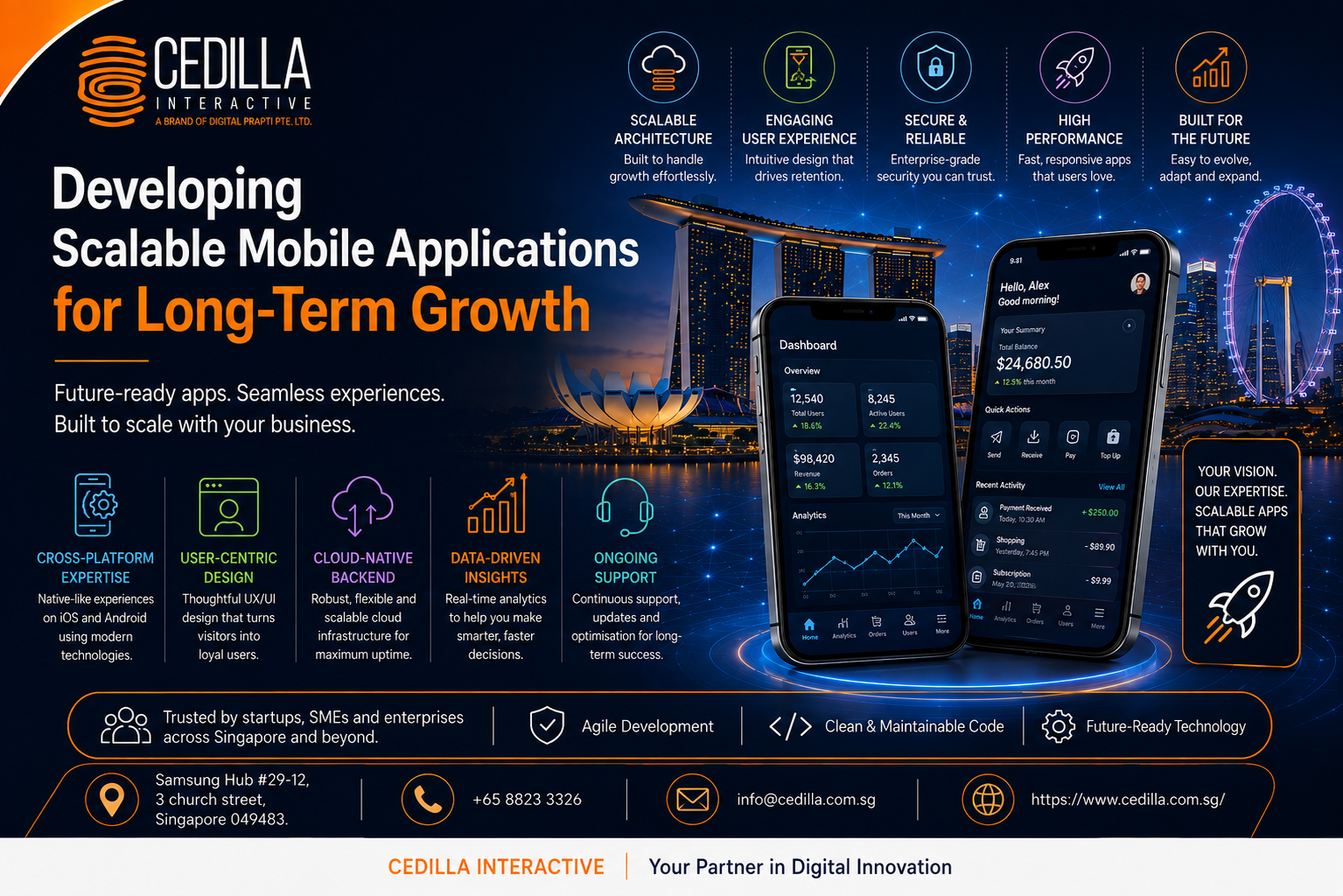
Building a mobile application is a deceptively approachable proposition in 2026. Development tools are accessible. No-code platforms offer apparent shortcuts. Offshore development markets offer low hourly rates. What none of these options reliably deliver is an application architecture that performs as well at scale as it does during initial launch, when the user base is small, transaction volumes are manageable, and the system has not yet encountered the edge cases that real-world growth inevitably generates. Mobile application development in Singapore through Cedilla Interactive begins from a fundamentally different premise: that an application's long-term scalability is not a feature to add later but an architectural decision made at the beginning. The cost of rebuilding an app that was not designed for scale is invariably greater than the cost of designing it correctly the first time.
What Scalability Actually Means in Mobile Application Architecture
The term scalability is used broadly in technology conversations and understood narrowly by most non-technical business owners. Mobile application development Singapore requires a precise understanding of what scalability means across the specific dimensions that mobile applications encounter as they grow.
Horizontal scalability involves increasing the capacity of a server system by adding more servers to run on in parallel with the existing system to support the growth of users, without having to rebuild the entire system. Ten-thousand users can use a mobile app with the same response time reliability that is provided to one hundred users, when more server resources are added, they are added automatically, instead of requiring manual action and potential downtime.
Data scalability is about the way an application's database architecture deals with the increasing amount, type and speed of data resulting from an increase in users. Singapore mobile application developers like Cedilla Interactive plan database schemas from the beginning, factoring in expected data growth scenarios without compromising query performance as data grows past their initial size estimates, through the selection of database technologies, indexing strategies and data partitioning plans.
Business owners know scalability the most, the capability to add new functionality to the system without destabilising everything else that's already there. Modular application design allows for additional features to be added, without the need to rewrite existing code for every product release.
Cross-Platform Development: Serving iOS and Android Without Doubling Cost
Singapore's mobile user base operates across both iOS and Android ecosystems. A mobile application development Singapore strategy that serves only one platform immediately excludes a significant proportion of the potential user base. Building separate native applications for each platform doubles development time, doubles ongoing maintenance cost, and creates version synchronisation challenges that compound as the application's feature set grows.
Cedilla Interactive's cross-platform development model provides truly native user experiences across iOS and Android with one shared code-base. This is not the same poor and disjointed experience that was achieved with the earlier cross-platform tools. The modern cross-platform frameworks provide rendering of the components using the native UI elements of the respective platform, which means that the interaction mechanisms and visual conventions are respected: iOS users get what they're used to, and Android users get what they're used to.
Singapore mobile app developer Cedilla Interactive have a strong knowledge of both frameworks, React Native and Flutter, and choose whichever is better suited to a particular project, rather than sticking with one they like more than the other. A development partner is different from a development vendor in that he/she will select the appropriate technology for your project.
User Experience Design That Determines Whether Users Return
Technical scalability is necessary but insufficient for mobile application success. Mobile application development Singapore projects fail commercially more often for UX reasons than for technical ones. An application that works correctly but creates friction, confusion, or cognitive load during routine interactions loses users to competitors whose products respect the limited patience that mobile users extend to any application that makes them think unnecessarily.
The process of user experience (UX) design at Cedilla Interactive starts with user journey mapping, which outlines all the user interaction paths of the app from initial launch to becoming an every day tool. This mapping is used to find friction points where users are losing flow and are not able to complete the action, for example because a form has too many fields; a navigation pattern is not mobile standard; or the loading state does not provide enough reassurance to the user that their action has been recorded.
On the usability front, Singapore UX work is not just about the design but also conducting usability testing with representative users before any code is written into the mobile apps. Testing paper prototypes and interactive wireframes with real members of the target user groups can solve UX problems at the lowest possible cost of remediation, before a single line of code is written to create an interface that would require remaking under real conditions for usability testing.
Post-Launch Support: Where Long-Term Growth Is Actually Enabled
Mobile application development Singapore project completion at launch is a milestone, not a conclusion. The months following launch are when the application's real-world performance under genuine user behaviour diverges from how it performed during controlled testing, generating the crash reports, performance metrics, and user feedback that inform the iterative improvements that determine whether an application grows its user base or plateaus after initial adoption.
Cedilla Interactive's post-launch support framework includes performance monitoring that tracks application response times, crash rates, and API failure events in real time, alerting the development team to emerging issues before user reviews begin reflecting them publicly. App store review monitoring provides qualitative signals about the user experience dimensions that quantitative monitoring does not surface directly.
Regular release cadence, managed updates that introduce improvements, address performance issues, and extend functionality without disrupting the stable experience that retained users depend on, requires the same disciplined engineering process that initial development demands. Mobile apps developer Singapore teams at Cedilla Interactive maintain this release discipline as a standard post-launch service rather than treating every update as an ad-hoc project requiring separate scoping and resourcing.