
 Enquire Now
 Call
Call Email
Email

 Wisma Atria #11 - 57, 435 Orchard Road Singapore 238877




September 05, 2026
Business Automation in Singapore: Smarter Operations with AI
Firms in Singapore are competing in an environment where efficiency, agility, and digitalisation have become core aspects of competitiveness. As businesses grow, the number of processes involved in daily operations also increases. Sales enquiries, customer data, approvals, accounting documents, report preparation, staff duties, communications, and service delivery all require coordination. Even small inefficiencies in these processes can eventually become a significant operational burden.
The challenge facing many firms today is not a lack of technology, but a lack of connected technology. Different departments may use different tools, while employees continue relying on spreadsheets and emails for everyday activities. Information can become isolated within individual applications, making it difficult for businesses to operate efficiently and maintain a complete view of their operations.
Understanding Business Automation Beyond Simple Task Automation
Business automation often begins with mundane activities, but modern automation has progressed far beyond simple task automation. Businesses can now automate complete processes that involve multiple systems, decision-making steps, and different sources of information.
For example, an organisation can create a process where a customer enquiry enters the system, relevant information is collected, the enquiry is assigned to the appropriate department, follow-up communication is initiated, and management can monitor the outcome. Similarly, document-heavy processes can be automated so that information is collected, verified, approved, and updated in business systems with minimal manual intervention.
Finding Opportunities Across the Entire Organisation
Business automation opportunities vary between companies and do not necessarily belong to a single department. An industrial enterprise may need better control over production and inventory management, while a professional services company may focus on project management and customer relationships.
A retail business may concentrate on customer interaction and order processing, while a logistics company may need to improve coordination between shipments, warehouses, suppliers, and customers.
Cedilla Interactive helps companies identify these opportunities according to their actual operating environment. We analyse where employees spend their time, where information is repeatedly processed, where delays occur, and which activities could be improved through technology.
Creating the Right Technology Foundation
Automation is most effective when the underlying technology environment supports it. Companies that depend on outdated software, disconnected databases, or incompatible systems may need to modernise their technology foundation before implementing advanced automation.
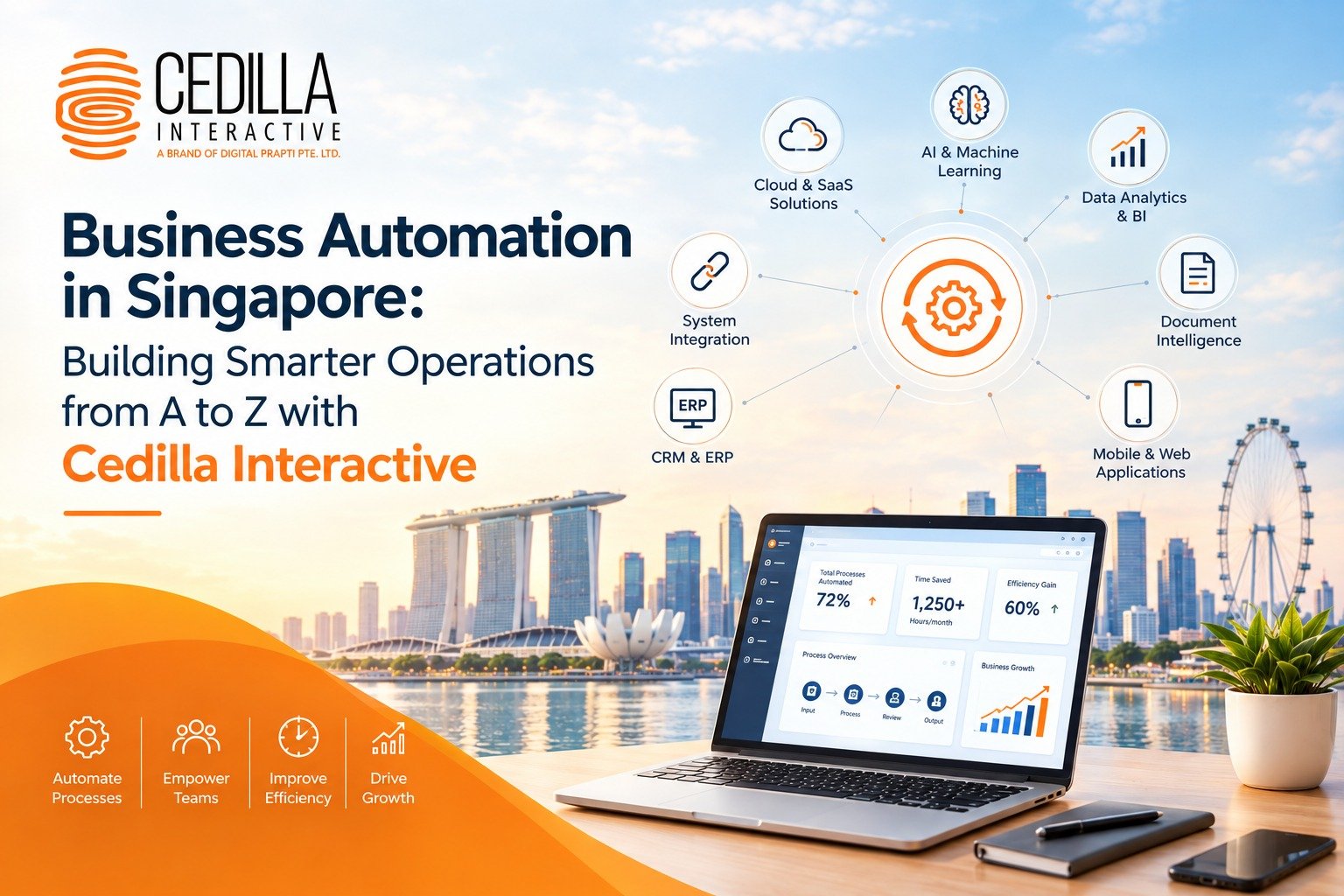
At Cedilla Interactive, we provide technology capabilities that support businesses at different stages of digital maturity. Our capabilities include enterprise software, CRM and ERP solutions, cloud and SaaS applications, mobile and web applications, workflow automation, AI and Machine Learning, AI Agents, Document Intelligence, and Data Analytics and Business Intelligence.
This broad technology capability allows us to select the most appropriate combination of technologies for each company's requirements. In some cases, an existing system may simply need to be integrated with another application. In other situations, it may be more effective to customise an application or redesign the workflow completely.
Where AI Changes the Automation Landscape
Artificial Intelligence has introduced a new level of business automation by enabling systems to process information that previously required considerable human understanding.
AI can support document comprehension, recognise patterns in business data, answer customer queries, assist business teams, and help organisations make sense of large volumes of information. AI Agents can also be designed to perform specific business tasks and interact with users according to defined objectives and workflows.
Cedilla Interactive can integrate AI technologies into existing business applications and automate processes in ways that introduce intelligence where it provides the greatest business value.
Automating the Flow of Information
Information is another critical component of every business and can become a major source of inefficiency when it is handled manually.
Employees may enter the same customer information into multiple applications, retrieve documents from emails before uploading them elsewhere, or manually compile reports using data from several different sources. These activities increase workload and create opportunities for inconsistencies and errors.
Cedilla Interactive can connect applications, transfer information automatically, trigger workflow actions, and create centralised visibility wherever required. This allows information to move through the organisation according to defined business rules instead of relying entirely on manual intervention.
Making Documents Part of the Digital Workflow
Documents continue to play a crucial role in the day-to-day operations of Singapore businesses, particularly where invoices, purchase orders, agreements, forms, applications, financial information, and compliance-related documentation are involved.
Simply digitising these documents does not necessarily make document management efficient. Employees may still need to read documents, extract relevant information, enter the data into another system, and manually move documents through approval processes.
Intelligent Document Processing and Document Intelligence can help businesses transform these document-heavy workflows by extracting relevant information, validating data, and connecting documents with the systems and workflows that depend on them.
Turning Business Data into Better Decisions
While automation helps complete tasks more efficiently, it can also improve the way business leaders understand the state of their organisation.
Data Analytics and Business Intelligence tools can bring information together through reports, dashboards, and analytical views. Business leaders can gain greater visibility into performance, trends, operations, and important business metrics.
When automation and analytics work together, organisations can create a more responsive operating environment. Routine tasks can be automated while decision-makers gain access to better and more timely information.
Automation Across Different Business Functions
A complete automation strategy can touch almost every area of an organisation depending on its requirements. The opportunities can range from customer-facing processes to internal administration, operational management, and business intelligence.
Common areas where automation can create value include:
Customer Management: CRM automation can organise customer information, enquiries, follow-ups, and communication while improving visibility for sales and service teams.
Finance and Administration: Businesses can automate invoice processing, approvals, notifications, reporting, and repetitive administrative activities.
Operations: Workflow automation can coordinate tasks between teams, systems, and approval stages while reducing unnecessary manual intervention.
Human Resources: Digital workflows can support employee onboarding, documentation, internal requests, approvals, and routine HR administration.
Sales and Marketing: Automated processes can support lead management, customer engagement, campaign activities, and follow-up workflows.
A Complete Partner Instead of Multiple Technology Vendors
One of the practical challenges associated with digital transformation is managing different technology providers for different requirements. Businesses may need one vendor for software development, another for AI, another for integrations, and another for ongoing support.
Cedilla Interactive provides a broader technology partnership model. Our capabilities allow us to address different aspects of business automation while maintaining a unified understanding of the client's overall objectives.
This approach can help businesses avoid fragmented technology decisions and create a more connected roadmap for their digital transformation initiatives.
From Automation Strategy to Ongoing Support
Effective automation requires continuity. A solution needs to be properly planned, developed, tested, implemented, and maintained if it is expected to deliver lasting value.
Cedilla Interactive supports businesses throughout this lifecycle. We begin by understanding the operational requirement and defining an appropriate technology approach. Our team then works through solution design, development, integration, testing, deployment, and refinement.
After implementation, ongoing support and optimisation help ensure that the solution continues to perform as business requirements change. New workflows can be introduced, existing functionality can be improved, and technology can evolve alongside organisational growth.
Why Cedilla Interactive for Business Automation in Singapore?
Cedilla Interactive combines software engineering, artificial intelligence, automation, cloud technologies, data intelligence, and business-focused solution development under one technology partnership. This enables us to look at automation from both technical and operational perspectives.
Our approach is centred on understanding the business first and then determining how technology can improve it. We focus on practical implementation, scalable architecture, system connectivity, usability, and long-term support rather than simply introducing technology for the sake of innovation.
Start Your Automation Journey with Cedilla Interactive
There is no single definition of an automated business. For one organisation, it may mean removing hours of repetitive administration. For another, it may involve connecting enterprise systems, introducing AI Agents, modernising applications, automating document processing, or creating a data-driven management environment.
Cedilla Interactive provides Singapore businesses with the capabilities to move from that first requirement to a complete automation ecosystem. Our role extends across strategy, technology development, integration, implementation, and ongoing improvement, giving businesses one partner for their automation requirements from A to Z.