
 Enquire Now
 Call
Call Email
Email

 Wisma Atria #11 - 57, 435 Orchard Road Singapore 238877




AI Agents

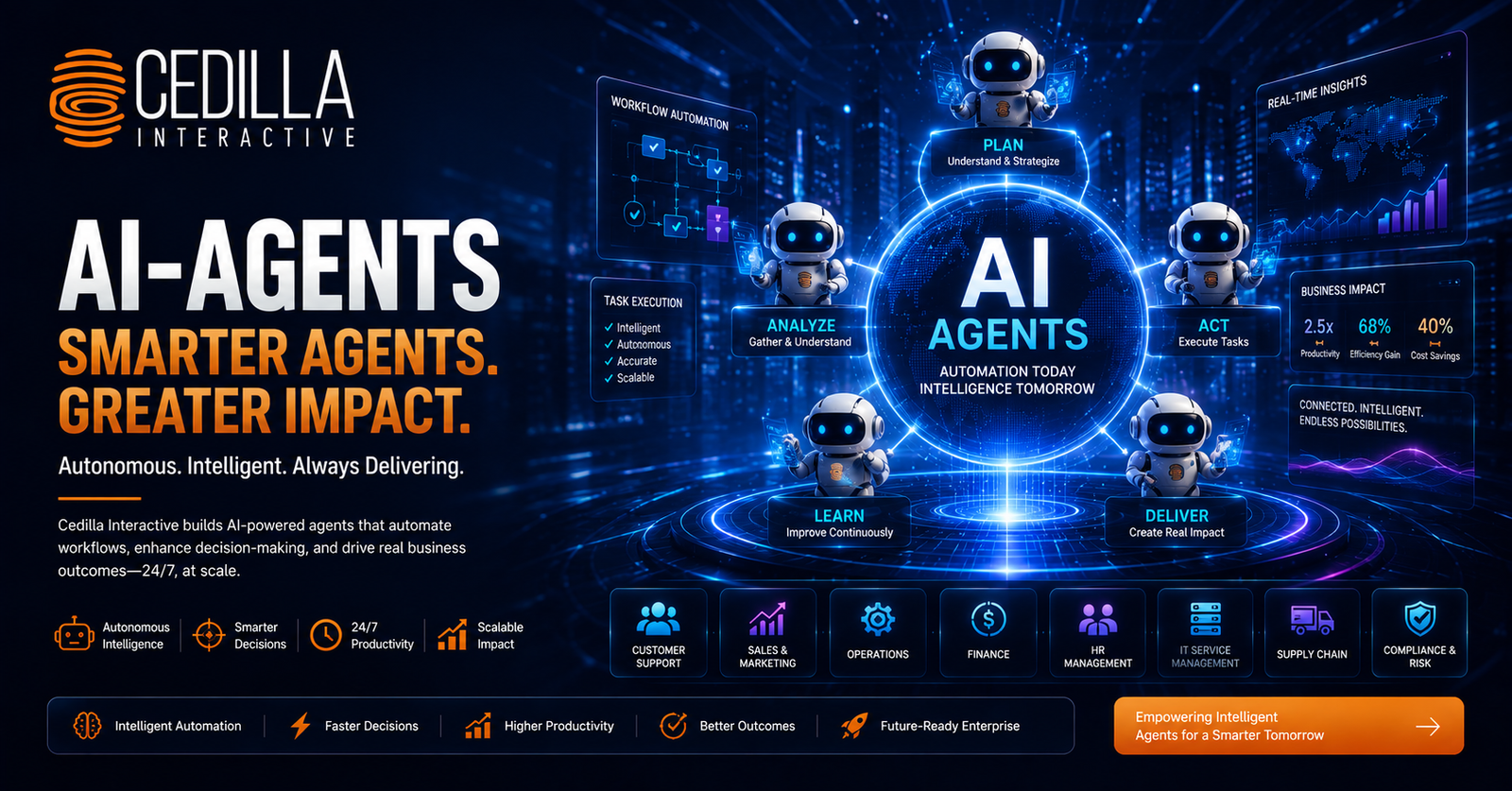

Empower Your Business with Intelligent AI Agents
The current era calls for faster reaction, individualised treatment, and 24/7 efficiency in business. Yet, performing the same actions, dealing with increasing customer queries, and analysing a large amount of data manually might take time and cost money. AI Agents provide a better approach to automate processes, aid in decision-making, and increase efficiency without getting rid of the people working there.
At Cedilla, we create and implement smart AI Agents that allow businesses to automate processes, communicate with users in a natural way, analyse data, and carry out tasks related to specific businesses fast and accurately. Be it customer service agents, virtual employees, sales assistants, process automation agents, or decision support systems – we have the right AI solution for your business needs.
What are AI Agents?
AI Agents are software programs that are capable of comprehending data, making decisions, executing tasks, and interacting with users without much need for human involvement. These agents have been created with the help of Artificial Intelligence, Machine Learning, and NLP, and thus they are capable of analysing data, responding to user's request, automating workflows, and continuously improving their performance.
As opposed to traditional automation tools that strictly adhere to certain predefined rules, AI Agents are capable of learning from experience and coping with changes and more complicated business processes. These agents can respond to customers' inquiries, analyze documents, schedule appointments, produce reports, recommend actions to be taken, and assist employees in their daily activities.
Why is it Important?
In order for enterprises to thrive in an ever-changing world, it becomes increasingly difficult to handle growing loads of work and maintain a good level of services provided.
AI Agents are solutions that help companies cope with the problem through automation of routine operations and provision of intelligent support whenever it is required. They operate all the time without taking any breaks, and it helps enterprises to react promptly, save effort and be consistent in their work.
Moreover, these intelligent systems increase engagement of customers through immediate assistance, personalization of suggestions and accuracy of information provided.
For internal purposes, AI Agents help employees to do administrative work, find necessary information and simplify workflows.
Through the introduction of AI Agents, companies are able to increase their productivity, cut expenses, create stronger connections with clients and build more agile companies.

Business Challenges
There is a problem of inefficiency in many organisations where employees have to deal with a lot of repetitive work, communication, and processing of information manually. AI Agents help solve these issues through intelligent automation and support. The following are some of the common business issues:
- Slow reaction time to customer inquiries
- Employee inefficiency due to repetitive tasks
- Expensive operations because of manual work
- Difficulties in handling growing number of customer contacts
- Inconsistencies in customer experience through different communication channels
- Decision making difficulties due to unorganised information
- Unavailability of support outside office hours
- Processing documents and information manually
- Collaboration and exchange of information between employees inefficiently
- Inability to scale customer support and business operations
At Cedilla, we develop AI Agents which automate processes in businesses.
Business Benefits
AI Agents help enterprises to automate their processes, engage customers and make their employees more productive. Using AI Agent solutions from Cedilla, businesses get an opportunity to enjoy such benefits as:
- Increased speed of responses to customer and employee inquiries
- Automation of repetitive tasks in business processes
- Enhancement of customer satisfaction with personalized customer service
- Employee and enterprise-wide productivity improvement
- Round-the-clock service without any need for extra personnel
- Smart decision-making and intelligence
- Cost and effort savings
- Continuous service delivery through various channels
- Integrations with existing business systems
- Scalable and growing AI solutions
Our AI Agents help enterprises to operate more efficiently with the help of intelligent automation and decision support.
Our Solution
In Cedilla, we create Customized AI Agents for your business processes, industry needs, and organizational goals. We concentrate on creating a practical implementation of AI that adds tangible business value by becoming an integral part of your technology ecosystem.
We start off by analyzing your challenges, looking for opportunities to automate them and defining the roles for your AI Agent.
Some of the tasks our AI Agent can do for you include
We pinpoint business problems, automation potential, and user needs in order to come up with the most efficient strategy for the development of an AI Agent.
Our specialists design advanced AI Agents with skills needed specifically for your business processes, customer journey, and business goals.
We develop AI Agents that can be easily integrated with CRM systems, ERP platforms, cloud solutions, databases, APIs, communication tools, and enterprise applications.
Our specialists train the AI models using appropriate business data.
All our AI Agents go through a full testing cycle to ensure that the AI Agent is reliable, secure, scalable, and performs well.
We offer you continuous monitoring, model updates, additional features, and technical support of the AI Agent.
Key Features
Enable natural, human-like conversations across websites, mobile applications, messaging platforms, and customer support channels.
Automate repetitive operational tasks such as scheduling, approvals, document processing, notifications, and information retrieval.
Allow AI Agents to understand user intent, answer questions accurately, and communicate naturally in multiple contexts.
Integrate AI Agents with CRM, ERP, cloud platforms, APIs, databases, email systems, and collaboration tools for seamless operations.
Provide employees and customers with instant access to business information, documentation, policies, and frequently requested resources.
Analyse business data and generate recommendations that support faster, data-driven decision-making.
Deploy AI Agents across websites, mobile apps, social media platforms, messaging applications, and customer service portals.
Build enterprise-grade AI Agents that maintain high performance, data security, and scalability as business requirements evolve.
Industries We Serve
We develop AI Agents that automate production monitoring, maintenance scheduling, quality control support, inventory enquiries, and operational reporting to improve manufacturing efficiency.
Our AI Agents provide personalised shopping assistance, automate customer support, manage product recommendations, process orders, and improve customer engagement across digital channels.
We build intelligent virtual assistants that support appointment scheduling, patient enquiries, administrative workflows, medical information management, and healthcare communication while maintaining data security.
Cedilla develops AI Agents that assist with customer onboarding, financial enquiries, document verification, fraud detection support, compliance processes, and account management.
Our AI solutions automate shipment tracking, warehouse enquiries, supplier communication, inventory updates, transportation coordination, and operational reporting.
We help organisations automate client communication, project management support, document retrieval, scheduling, internal knowledge management, and administrative workflows.
Our AI Agents assist with student admissions, course enquiries, learning support, administrative tasks, scheduling, and personalised educational experiences for institutions and learners.
Why Choose Cedilla?
Implementing AI Agents requires expertise in artificial intelligence, enterprise software, business process automation, and system integration. At Cedilla, we combine advanced AI capabilities with practical business knowledge to develop intelligent agents that solve real operational challenges and deliver measurable business outcomes.
Our experienced team collaborates closely with clients to understand their objectives, design customised AI solutions, and integrate them seamlessly into existing business environments. We focus on building secure, scalable, and user-friendly AI Agents that improve efficiency without disrupting established workflows.
FAQs
AI Agents are software programs that understand data, make decisions, execute tasks, and interact with users without much need for human involvement. Built with Artificial Intelligence, Machine Learning, and NLP, they answer customer enquiries, analyse documents, schedule appointments, produce reports, recommend actions, and support employees in their daily work.
- Traditional automation: Follows strictly predefined rules and breaks when conditions change
- AI Agents: Learn from experience and cope with change and more complex business processes
- Our approach: Agents are designed to support your people, not replace them — handling repetitive work so staff focus on higher-value activity
- Manufacturing — production monitoring, maintenance scheduling, inventory enquiries
- Retail & E-commerce — shopping assistance, product recommendations, order processing
- Healthcare — appointment scheduling, patient enquiries, administrative workflows
- Financial Services — onboarding, document verification, fraud detection support
- Logistics, Professional Services & Education — enquiries, scheduling, knowledge management
- Discover — identifying business problems, automation potential, and user needs
- Design — defining the agent's capabilities around your processes and customer journey
- Build — development and integration with CRM, ERP, cloud, databases and APIs
- Train — training the AI models on appropriate business data
- Validate — full testing for reliability, security, scalability, and performance
- Support — continuous monitoring, model updates, and technical support
Yes. Our AI Agents integrate with CRM systems, ERP platforms, cloud solutions, databases, APIs, email, and collaboration tools, and can be deployed across websites, mobile apps, social media, messaging applications, and customer service portals. Deployment is enterprise-grade — maintaining performance, data security, and scalability as your requirements evolve, and integrating without disrupting established workflows.