
 Enquire Now
 Call
Call Email
Email

 Wisma Atria #11 - 57, 435 Orchard Road Singapore 238877




Document Intelligence

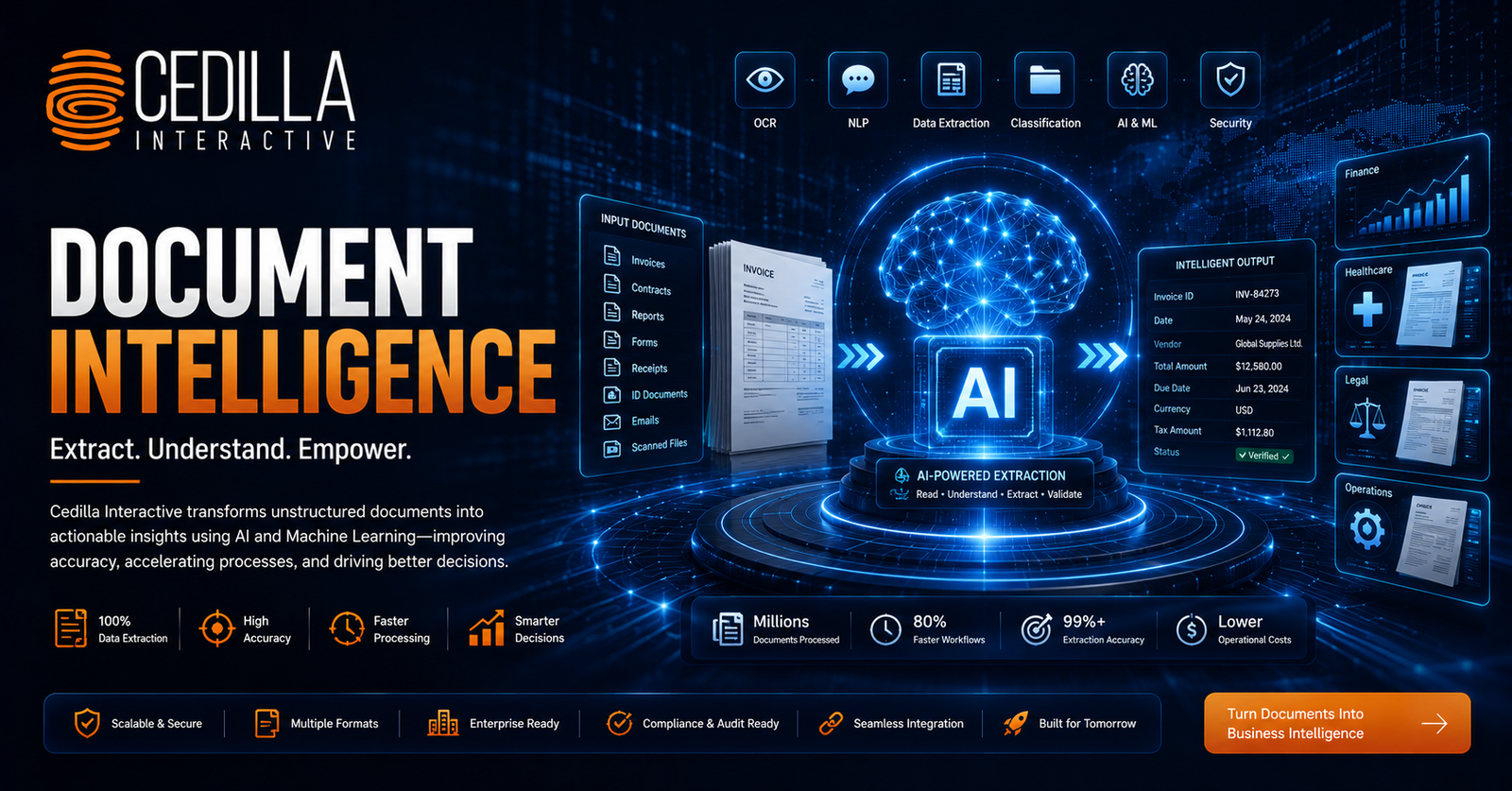

Transform Business Documents into Actionable Intelligence
Every business deals with numerous amounts of paperwork daily including bills, contracts, purchase orders, forms, reports, customer information, compliance papers, and many more. Processing such documents manually might be lengthy, error-prone, and hard to scale. The Document Intelligence approach uses AI, OCR, and ML to extract information from structured as well as unstructured documents.
At Cedilla, we provide intelligent solutions for Document Intelligence that will help businesses automate their document processing procedures, minimize manual processing, and increase accuracy of their data. If you require automated invoice processing, contract analysis, document classification, or intelligent data extraction, our solutions will allow you to process information faster and confidently.
What is Document Intelligence?
Document Intelligence refers to artificial intelligence-based systems that automatically understand, extract, organize, and process information contained in physical and electronic documents without the need for manual inspection of the paperworks. These systems process the contents of the document and then extract useful information.
The technologies involved in these systems include Artificial Intelligence, Machine Learning, Optical Character Recognition, and Natural Language Processing among others. They help in extracting the text, understanding the document layout, classifying the document and validating the extracted information.
Examples of the business documents that can be processed by Document Intelligence include invoices, purchase orders, contracts, employee information, financial statements, medical documents, legal agreements, applications from customers, and other compliance documents.
Why is it Important?
Modern businesses process and handle thousands of documents on a daily basis. Manual document management can lead to delayed processes, higher operational costs, and errors due to human mistakes.
Document Intelligence allows businesses to automate routine document processing while maintaining the highest possible degree of precision and accuracy. Employees do not have to waste time on manual entry and search for information but can concentrate on other valuable tasks.
Another benefit of document intelligence is the increased speed and quality of decision-making. With automatic validation, classification, and data extraction, employees receive timely and precise information about the business.
With the growth of digitalization of businesses, Document Intelligence is becoming a vital instrument for modern companies.

Business Challenges
Many organizations face problems with inefficient document management systems that affect their productivity and performance. Document Intelligence helps solve such problems through automation of document processing and improving the availability of information. The following are some of the common business challenges that organizations face:
- Manual document entry taking up precious employees' time
- Errors when extracting data from the documents
- Slow document approval and verification process
- Hard to find business documents
- Unstructured document numbers
- Document classification and organization problems
- Business risks as a result of improper record keeping
- High operation cost through manual processing
- Poor decision making owing to lack of access to information
Cedilla has developed intelligent document processing solutions to ease document management.
Business Benefits
Document Intelligence allows companies to automate document-based processes by increasing efficiency and improving the quality of data. Through automating processes, organizations are able to speed up processes and increase business efficiency. Using the Document Intelligence solutions provided by Cedilla, organizations can achieve:
- Fast document processing and approval times
- Decreased manual input and processing of data
- Higher accuracy of information extraction
- Greater compliance and document governance
- Increased visibility into the document process
- Improved accessibility of critical information
- Decreased cost of operations through automation
- Increased efficiency of employees
- Customer satisfaction due to increased efficiency of processing
- Scalable document management for expanding organizations
Our solutions assist organizations to turn documents into digital assets which facilitate better decision-making and efficiency in business.
Our Solution
We at Cedilla offer tailor-made solutions for Document Intelligence that fit flawlessly into your business processes and enterprise systems. Our expertise lies in assisting companies in automating their document-centric processes with efficiency, speed, and accuracy.
We begin by comprehending your document flow, your business goals, and your requirements and then go ahead with the creation of intelligent AI-based solutions to automate document intake, classification, extraction, validation, and processing, all with the same level of security and reliability.
Our Document Intelligence Implementation Process includes
We assess your current document processes, find manual steps that slow down progress, and figure out how intelligent automation can benefit your company.
Our specialists will create a unique solution for your documents, rules and requirements.
We develop models that can detect, extract and validate data in structured, semi-structured and unstructured documents.
Our solutions are integrated with ERP systems, CRM systems, document management systems, cloud storage, databases and other enterprise applications.
Each solution is tested for high accuracy, security, performance and scalability prior to its implementation.
We constantly monitor the system performance, optimize our intelligent models, release new software updates and provide technical support to your organization.
Key Features
Automatically capture documents from multiple sources, including scanned files, emails, cloud storage, and digital uploads.
Convert printed and handwritten text into searchable, editable digital information with high accuracy.
Extract key information from invoices, contracts, forms, reports, and business documents without manual intervention.
Automatically identify, categorise, and organise documents based on predefined business rules and AI-driven analysis.
Validate extracted information against business rules and existing systems to improve accuracy and reduce processing errors.
Trigger automated approval processes, notifications, and document routing based on predefined workflows.
Integrate Document Intelligence solutions with CRM, ERP, HR systems, cloud platforms, databases, and third-party business applications.
Protect sensitive business information through encryption, access controls, audit trails, and compliance-ready security practices.
Industries We Serve
We automate the processing of purchase orders, supplier invoices, quality inspection reports, compliance documents, and production records to improve operational efficiency.
Our solutions simplify invoice processing, supplier documentation, inventory records, customer forms, returns management, and order documentation while improving workflow accuracy.
We develop intelligent document processing solutions for patient records, insurance claims, medical reports, prescriptions, consent forms, and healthcare compliance documentation.
Cedilla automates loan applications, account opening documents, financial statements, KYC verification, compliance records, and transaction documentation with enhanced accuracy and security.
Our Document Intelligence solutions streamline shipment documentation, delivery records, customs paperwork, inventory reports, procurement documents, and supplier contracts.
We help organisations automate contract management, proposal processing, employee records, client documentation, legal agreements, and business correspondence.
Our solutions simplify admissions documentation, student records, examination forms, certificates, faculty documents, financial records, and institutional administration.
Why Choose Cedilla?
Successful Document Intelligence implementation requires expertise in Artificial Intelligence, document processing, enterprise integration, and workflow automation. At Cedilla, we combine advanced AI technologies with a strong understanding of business operations to deliver intelligent document solutions that create measurable business value.
Our experienced team works closely with clients to understand their document management challenges and develop customised solutions that integrate seamlessly with existing business systems. We prioritise accuracy, security, scalability, and user experience to ensure every solution improves operational efficiency while supporting long-term business objectives.
FAQs
Document Intelligence uses AI-based systems to automatically understand, extract, organise, and process information held in physical and electronic documents — without manual inspection. It combines Artificial Intelligence, Machine Learning, OCR, and Natural Language Processing to read text, understand document layout, classify documents, and validate the extracted information.
- Financial — invoices, purchase orders, financial statements, transaction records
- Legal & compliance — contracts, legal agreements, compliance documentation
- People & customer — employee information, customer applications, forms
- Our approach: Models handle structured, semi-structured, and unstructured documents alike, including printed and handwritten text
- Manufacturing — purchase orders, supplier invoices, quality inspection reports
- Retail & E-commerce — invoice processing, supplier and order documentation
- Healthcare — patient records, insurance claims, prescriptions, consent forms
- Financial Services — loan applications, KYC verification, compliance records
- Logistics, Professional Services & Education — customs paperwork, contracts, student records
- Assess — reviewing current document processes and manual bottlenecks
- Design — a solution built around your documents, rules, and requirements
- Build — intelligent models that detect, extract, and validate data
- Integrate — connecting ERP, CRM, document management, cloud storage and databases
- Validate — testing for accuracy, security, performance, and scalability
- Support — monitoring, model optimisation, updates, and technical support
Extracted information is validated against your business rules and existing systems before it reaches downstream processes, which reduces processing errors, and models are continuously monitored and optimised after deployment. Sensitive information is protected through encryption, access controls, audit trails, and compliance-ready security practices, with every solution tested for accuracy, security, performance, and scalability before implementation.