
 Enquire Now
 Call
Call Email
Email

 Wisma Atria #11 - 57, 435 Orchard Road Singapore 238877




Workflow Automation

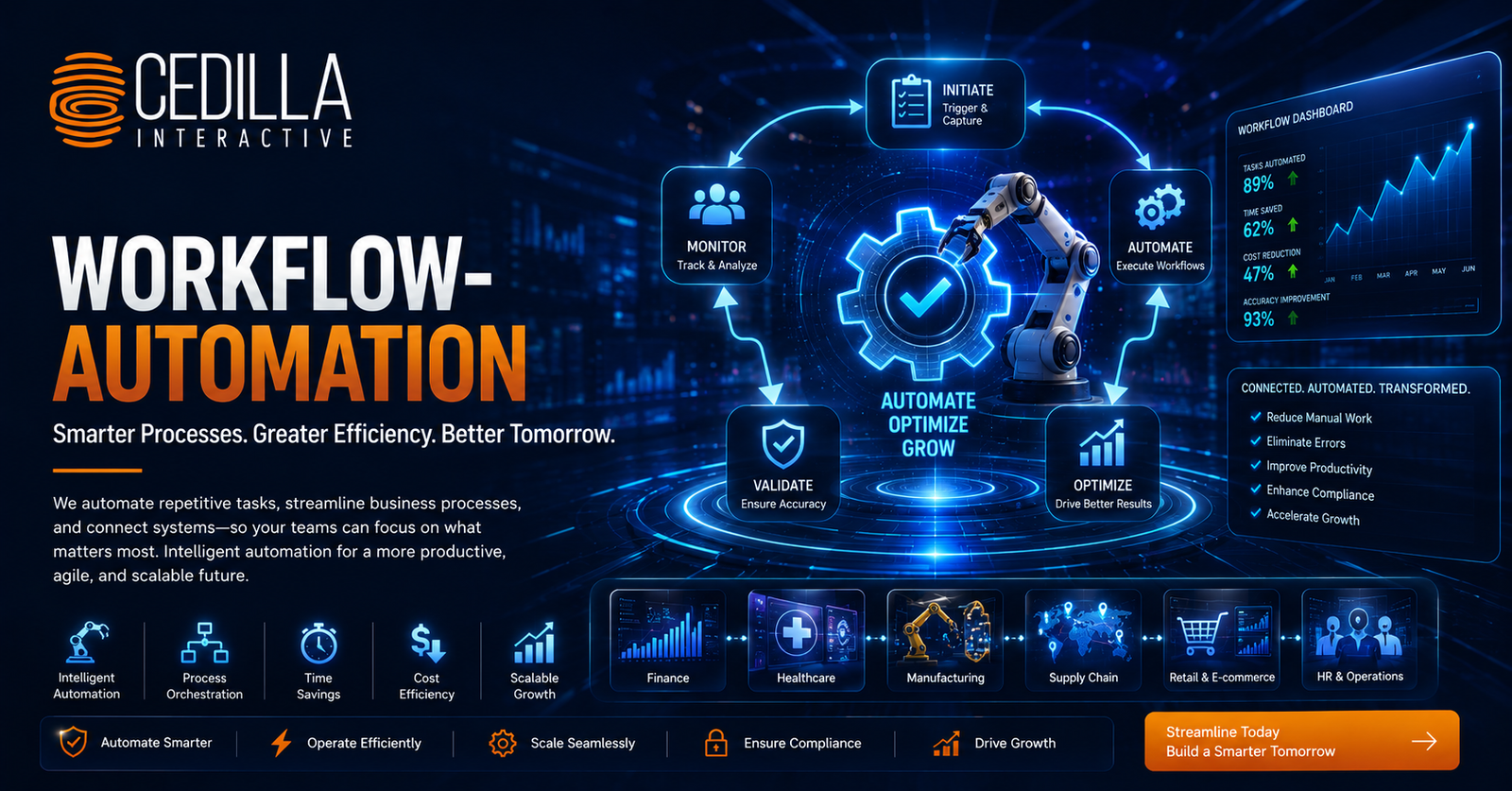

Automate Repetitive Processes and Improve Business Efficiency
Today's companies need to carry out a multitude of processes each day such as the processing of approval requests, handling of customer inquiries, data entry, etc. Although these tasks are critical, manual completion of these processes tends to cause delays, errors, higher operating costs and lower productivity. Through Workflow Automation, firms can automate routine processes and help their staff concentrate on the high-value activities that grow the business.
At Cedilla, we assist in automating the complicated workflows of your company through technologies that make the operation easy, foster collaboration and quicken the decision making process. We offer workflow automation services that help integrate people, systems and business processes into one seamless digital environment. For any type of process automation including approvals, document management, customer onboarding, reporting and more, we provide tailor-made solutions.
What is Workflow Automation?
Workflow Automation refers to the use of technology to perform repetitive business activities and operations with minimum human intervention. Rather than using emails, spreadsheets, and paper documents, Workflow Automation ensures that the tasks flow through specific stages quickly and reliably.
Workflow Automation software performs activities such as approvals, notifications, document management, assignment of tasks, customer support activities, invoice management, on-boarding of employees, updating inventory, and creating reports for businesses.
Workflow Automation works together with other business software, and this allows information to be transferred from one department to another automatically. This increases efficiency, consistency, and control over operations for businesses.
Through automation, businesses can enhance their productivity and lower their risk of making mistakes while providing improved service for employees and customers.
Why is it Important?
Companies have to react fast to the requirements of their clients, to the dynamics of the markets, and also to the issues they face within their organisation. Manual processes often lead to inefficient business process management, creating delays and causing unnecessary extra efforts of the administration of the company.
Workflow Automation allows companies to get rid of tedious manual tasks while increasing speed, accuracy, and visibility of the business processes. Through automation of the processes, it is ensured that all the tasks are done efficiently in accordance with business rules.
Since companies continue to grow, they have to manage more workload manually, which is becoming harder. Automated workflow ensures scalability and allows companies to manage a bigger workload.
Workflow Automation assists companies in cost savings, compliance management, customer satisfaction, and also better decision making thanks to process visibility.

Business Challenges
Organizations encounter inefficiency issues since some important processes within the business are still reliant on manual action. Workflow Automation solves these challenges by automating processes in an intelligent manner and creating efficient business operations. The main problems organizations face are:
- Manual and time-consuming processes
- Delayed approval and decision-making processes
- Repetitive tasks leading to human errors
- Inconsistencies in business processes among different departments
- Lack of visibility of the processes and their performance
- Data entered twice in different systems
- Inefficient communications between employees
- Difficulties in complying with regulations
- Expensive operations due to manual administration
- Non-scalability of the business operations
Cedilla designs workflow automation solutions that streamline business operations.
Business Benefits
Workflow Automation helps organisations boost their operational efficiency and effectiveness by cutting down manual work and administrative tasks. With the help of our Workflow Automation software products, your organisation will be able to:
- Achieve faster completion of routine business tasks
- Decrease manual effort and administrative work
- Increase operational efficiency within various business units
- Increase process accuracy thanks to less human errors
- Gain real-time visibility over the workflow status
- Improve team cooperation
- Answer the requests of customers quickly
- Comply with regulatory requirements thanks to standardized processes
- Reduce operating costs and optimize resource allocation
- Be more agile and scalable for future growth
Our automation software products help you build smarter workflows.
Our Solution
Cedilla’s Workflow Automation is specifically designed for you, based on your business processes, needs and IT environment. Instead of using off-the-shelf automation tools, we tailor unique workflow automation solutions for you to increase efficiency and integrate seamlessly into your business processes.
It all starts by analyzing your current processes, finding their bottlenecks and exploring automation potential in order to get you the best possible business results.
The Workflow Automation process at Cedilla includes
Existing processes are examined, repetitive actions are identified, and possibilities to make business more efficient by implementing automation are considered.
Our specialists prepare smart workflow models which make your business process simpler and meet organizational goals.
We prepare customized automation tools which use contemporary technologies and can be integrated into your existing software or enterprise platforms.
Our automation solutions work together with your CRM, ERP, HR system, financial software, cloud-based platforms, document management systems, and third-party systems.
All workflows are carefully tested for their efficiency, security, and reliability.
We control performance of your workflows and provide necessary improvements and technical support.
Key Features
Automate business tasks which are repeated through workflows that increase speed, efficiency, and effectiveness.
Manage the approval of business processes related to financial, procurement, HR, operations, and management with automated routing and notification.
Automatically manage the creation, organization, processing, and management of documents, while minimizing paper.
Automatically assign tasks, issue reminders, and notify staff about their task responsibilities at each step in the workflow.
Connect various business applications in order to facilitate the sharing of information between different departments and platforms.
Monitor the progress of your workflow through the use of dashboards, reports, and performance analytics.
Set up your workflows according to the business rules that have been defined beforehand.
Deploy scalable automation solutions to adapt to your growing business needs.
Industries We Serve
Approval of manufacturing process, procurement, maintenance, inventory management, quality assurance, and production reporting are streamlined through automated workflows.
Order processing, inventory update, customer support, supplier collaboration, return management, and fulfillment operations are automated using Cedilla’s Workflow Automation solutions.
Patient registration, appointment booking, documentation, billing, approvals, and administrative functions are automated while ensuring effective service delivery.
Workflows for customer onboarding, loan approval, compliance management, document verification, financial reporting, and transaction processing are developed by Cedilla.
Shipment tracking, warehouse operations, procurement approval, inventory management, logistics management, and communication with suppliers are optimized using our automation solutions.
Project approvals, contract management, resource allocation, invoice processing, document management, and client communication are made easy using intelligent automation.
Admissions, student registration, fee collection, faculty approvals, examinations, administration, and communication processes are automated using our solutions.
Why Choose Cedilla?
Successful Workflow Automation requires a deep understanding of business operations, process optimisation, and enterprise technology. At Cedilla, we combine business expertise with modern automation technologies to deliver solutions that improve efficiency, eliminate operational bottlenecks, and support long-term digital transformation.
Our team works closely with clients to analyse existing workflows, identify automation opportunities, and develop tailored solutions that integrate seamlessly with current systems. We focus on creating scalable, secure, and user-friendly automation platforms that enhance productivity without disrupting business operations.
What sets Cedilla apart is our commitment to delivering automation solutions that generate measurable business value. We prioritise process optimisation, seamless integration, continuous improvement, and reliable support to help organisations reduce costs, improve operational visibility, and accelerate business performance. With Cedilla as your automation partner, your business can operate more efficiently, respond faster to changing demands, and build a strong foundation for future growth.
FAQs
Workflow Automation is the use of technology to run repetitive business activities with minimum human intervention. Instead of chasing approvals over email, spreadsheets, and paper forms, tasks move through defined stages automatically — covering approvals, notifications, document handling, task assignment, invoice processing, employee onboarding, inventory updates, and reporting.
- High-volume, repetitive tasks — data entry, status updates, routine reporting
- Approval-heavy processes — purchase requests, leave, expenses, contracts
- Processes prone to error or delay — document verification, invoice handling, onboarding
- Our approach: The discovery stage identifies the bottlenecks with the highest impact, so the first automation delivers value quickly
- Manufacturing — procurement, maintenance, quality assurance, production reporting
- Retail & E-Commerce — order processing, inventory updates, returns and fulfillment
- Healthcare — registration, appointments, documentation, billing and approvals
- Financial Services — onboarding, loan approvals, compliance and document verification
- Logistics, Professional Services & Education — approvals, administration and communication
- Discover — mapping existing processes and identifying repetitive actions
- Design — workflow models aligned to your business rules and goals
- Build — customized automation developed on modern technologies
- Integrate — connecting CRM, ERP, HR, finance, cloud and document systems
- Validate — testing workflows for efficiency, security, and reliability
- Support — performance monitoring, optimisation, and technical support
No. Our automation solutions are built to integrate with the software you already run — CRM, ERP, HR systems, financial software, cloud platforms, document management, and third-party systems — so information moves between departments without duplicate entry. We roll workflows out in stages, test each one before deployment, and provide user training and ongoing support, so productivity improves without disrupting day-to-day operations.